Golf Cart Dimensions and Turning Radius Guide
How to read body dimensions, wheelbase, track and turning radius on a golf cart specification, and what to measure on site before ordering.
Quick answer
Read length, width, height, wheelbase and turning radius together: a 3.67 m six-seater turns in about 4.5 m, so measure the narrowest gate and parking bay before ordering.
A specification sheet describes the space a golf cart occupies when parked. A route needs the space it sweeps when moving, and the two are not the same. A cart that fits the gate can still fail a tight corner if the wall is close, and a cart that fits its parking bay can block a service corridor while charging.
This guide explains each dimension, compares the published figures and sets out the measurements to take before quoting.
What does each dimension on the specification sheet measure?
Body dimensions give overall length, width and height. Ask what the height includes: the roof, a light bar, a folded windshield or a rack can all change it.
Wheelbase is the distance between the centre of the front axle and the centre of the rear axle. It describes where the cart pivots and how much of its length sits between the wheels.
Track is the distance between the left and right tyres on an axle. The lithium range publishes 1030 / 1030 mm front and rear; the GC-A lists 1350 mm and the GC-B 1290 mm.
Minimum turning radius is the radius of the tightest circle the cart can drive. Confirm whether the figure is measured to the outer wheel, the body corner or the centreline, because the difference matters at a wall.
How much space does each model need to turn?
| Model | Seats | Body dimensions (L × W × H) | Wheelbase | Track (front / rear) | Turning radius | Clearance |
|---|---|---|---|---|---|---|
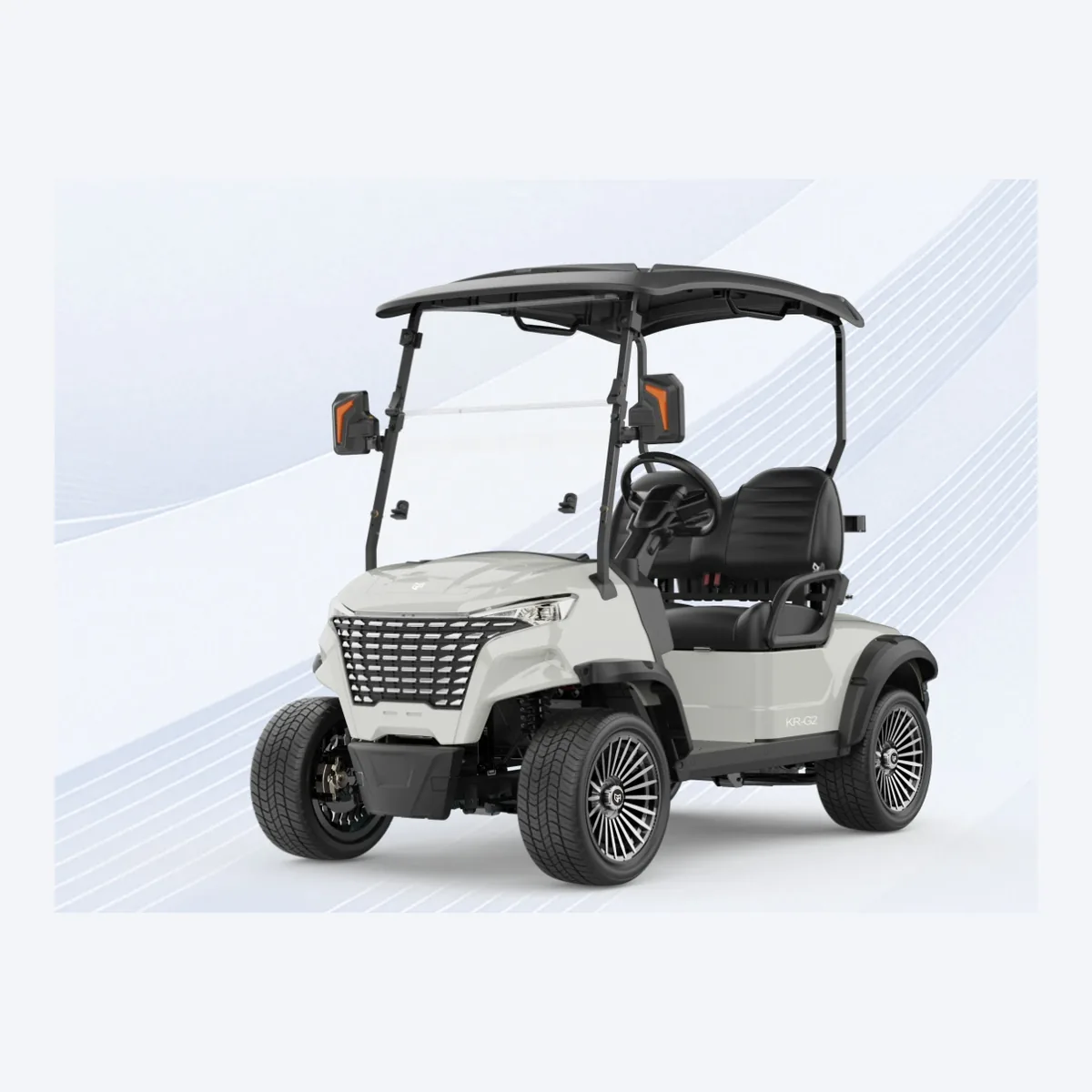
| KR-G2 | 2 | 2370 × 1340 × 2000 mm | 1675 mm | 1030 / 1030 mm | 4 m | 140 mm |
| KC-G2+2H | 4 | 2430 × 1330 × 2040 mm | 1675 mm | 1030 / 1030 mm | 4 m | 190 mm |
| KC-P4 | 4 | 2935 × 1270 × 2000 mm | 2075 mm | 1030 / 1030 mm | 4 m | 140 mm |
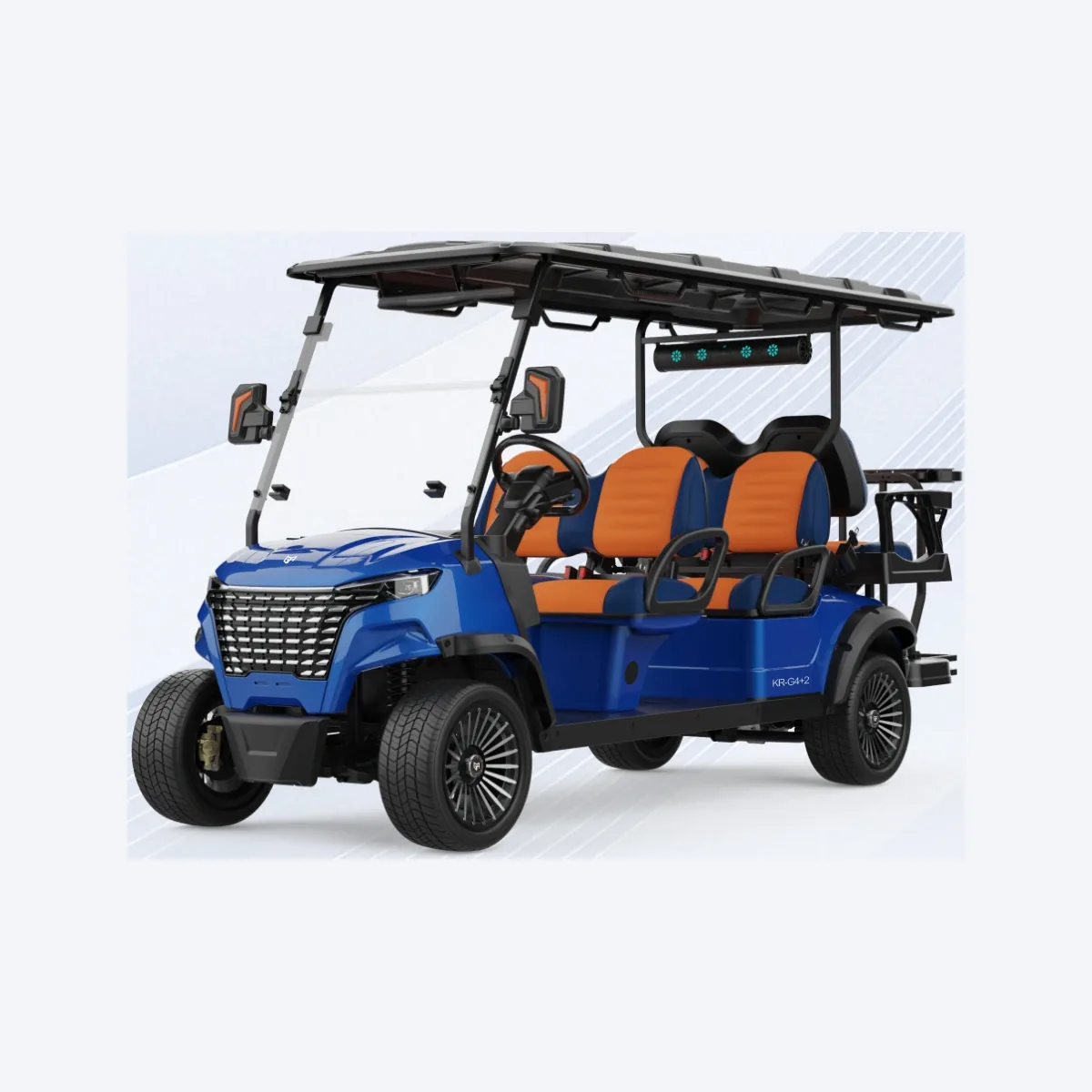
| KR-G4+2 | 6 | 3670 × 1340 × 2000 mm | 2420 mm | 1030 / 1030 mm | 4.5 m | 140 mm |
| KC-P6H | 6 | 3780 × 1270 × 2080 mm | 2860 mm | 1030 / 1030 mm | 4.5 m | 190 mm |
| KR-P6 | 6 | 3720 × 1270 × 2000 mm | 2860 mm | 1030 / 1030 mm | 5 m | 140 mm |
Two models share a 1675 mm wheelbase and a 4 m radius: the KR-G2 and the KC-G2+2H. The KC-P4 has a 2075 mm wheelbase and still turns in 4 m. The KR-P6 and KC-P6H share a 2860 mm wheelbase but publish 5 m and 4.5 m respectively. Wheelbase alone does not predict the turning circle; steering geometry and body width also count. Compare the radius for the exact model.
The GC-A and GC-B publish body dimensions and track but no turning radius. Both are longer than the compact lithium models, so request it before planning a tight route.
Why is wheelbase more useful than overall length?
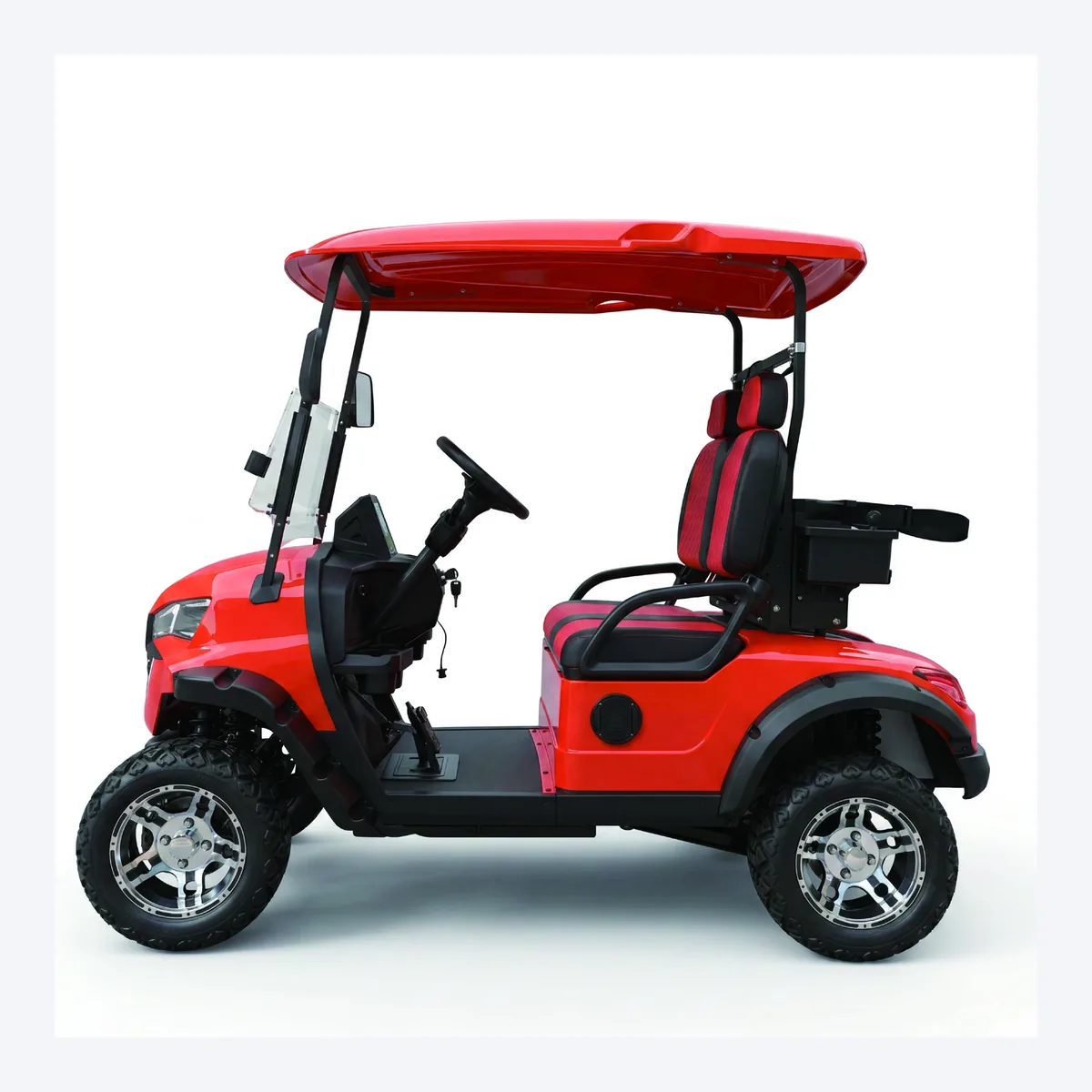
Wheelbase tells you how the cart pivots. A long rear overhang, common on utility models with a flatbed, swings wider than the wheelbase suggests. The 3720 mm KR-P6 publishes a 5 m radius, while the 3670 mm KR-G4+2 with a shorter 2420 mm wheelbase publishes 4.5 m; the difference reflects both wheelbase and body geometry.
Overall length still matters for parking and storage. A 3780 mm KC-P6H will not fit a bay planned around a 2370 mm KR-G2.
Use length as the first filter and wheelbase plus turning radius for the route survey. A longer wheelbase usually rides more calmly over joints and gravel, but it needs more room at the tightest corner.
What should you measure on site?
Take a tape measure and a phone camera, and record each point:
- the narrowest gate, doorway or arch on the route, in both width and height
- the path width at the tightest point, allowing for mirrors and passing pedestrians
- the outside clearance at the sharpest corner, including walls, planters, ditches and signs
- the width and posted load of any bridge or boardwalk
- the length and depth of the parking bay, plus the door opening if the cart is stored inside
- the charging position, the distance from the socket and whether the cart can leave forward
- the approach and lip of every ramp, kerb and drainage channel
Body width is 1270 mm to 1350 mm and height is 1900 mm to 2080 mm. Those ranges look small on paper but decide whether a cart passes a service door. A 2080 mm model needs 80 mm more headroom than a 2000 mm model before any roof rack is added.
How do dimensions affect parking and charging?
Parking is a length problem. A two-seat KR-G2 is 2370 mm long; a six-seat KR-G4+2 is 3670 mm and a KC-P6H is 3780 mm. A bay sized for a two-seater will leave a six-seater overhanging the aisle. The same applies indoors, where the roof height of 2000 mm to 2080 mm must clear the door.
Charging is a turning problem. The onboard 25 A charger on the lithium models brings the pack back in five hours or less, so the cart sits still for a working half-day. The charging position should let the cart enter and leave forward, with the socket within reach and the body clear of the aisle.
If the yard is tight, measure the approach to the charger as carefully as the bay. A cart that can reach the socket but cannot turn out will be charged in the wrong place within a week.
When is the compact model worth the smaller footprint?
The KC-G2+2H carries four adults in 2430 mm and turns in 4 m, with 190 mm of clearance. It suits a hotel forecourt, a clubhouse loop or an estate drive where the cart shares space with cars and pedestrians.
The GC-B is another compact option with a different shape: 2950 × 1290 × 1900 mm, four forward-facing seats, a 60 V 105 Ah lead-acid pack and a 60 km range. It is 520 mm longer than the KC-G2+2H but 40 mm narrower and 140 mm lower. On a low doorway or a narrow lane, width and height can matter as much as length.
Do not choose the shortest cart by reflex. Where the route is open and the turning areas are wide, a longer model may be more comfortable and carry more.
How should dimensions be confirmed before ordering?
Ask for a dimensioned drawing with the quotation, not only the marketing table. It should state the measurement points, whether mirrors and racks are included, the tyre size and whether the curb weight excludes the battery. Confirm the turning radius method and the condition used for the clearance figure.
The published numbers are a starting point. The drawing is what the site team should measure against, and the route survey turns a specification into a decision.
The questions that decide the order.
Is turning radius measured to the wheel or to the body?
Methods differ between suppliers. Some figures describe the outer wheel path, others the body corner or the centreline. Confirm the method used for the model you are buying and add a working margin at walls, kerbs and planters. A radius is a circle, not a corridor width.
How wide is a golf cart?
Body width across the current range is 1270 mm to 1350 mm. The GC-A is 1350 mm wide and the GC-B is 1290 mm. Mirrors, racks and optional storage add to that figure, so measure the narrowest gate with the options fitted.
Can a six-seat cart use a two-seat parking bay?
Not comfortably. A two-seat KR-G2 is 2370 mm long, while six-seat models run from 3670 mm to 3780 mm. Plan the bay length and the aisle behind it for the largest model in the fleet, not the average.
Does a longer wheelbase make the ride better?
A longer wheelbase usually rides more calmly over path joints and gravel, but it needs a larger turning circle. The KR-P6 and KC-P6H share a 2860 mm wheelbase yet publish 5 m and 4.5 m turning radii, so compare the radius itself rather than the wheelbase alone.