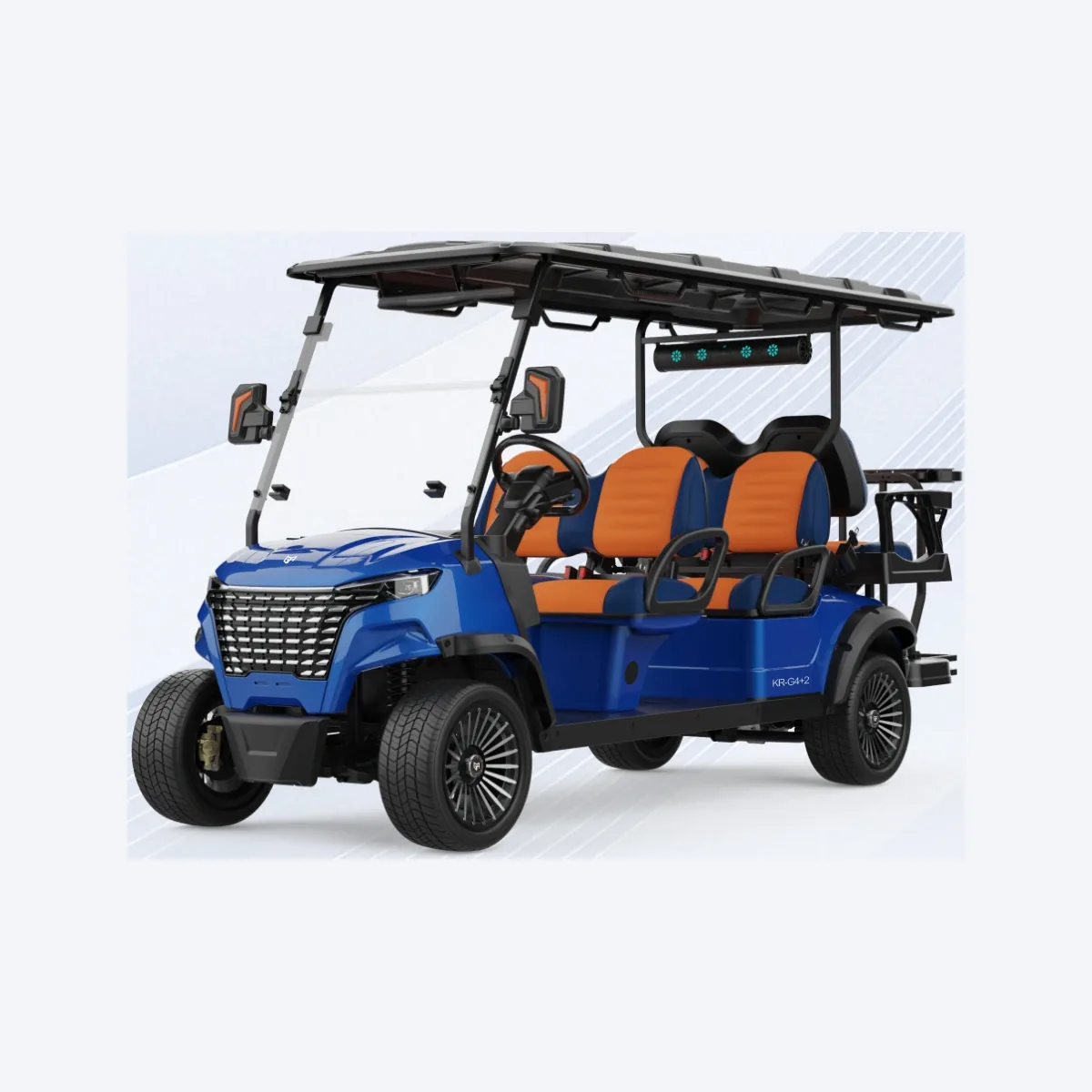
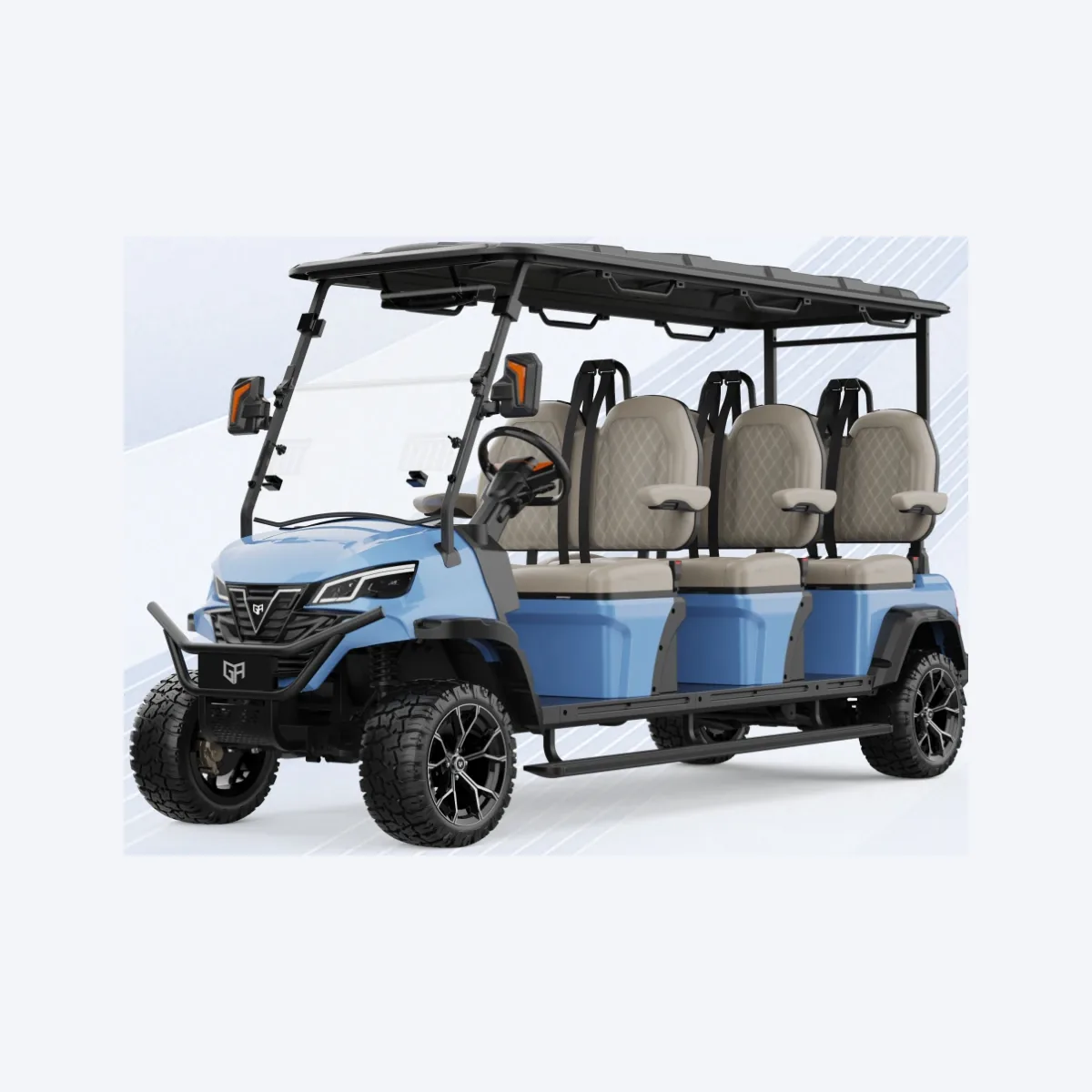
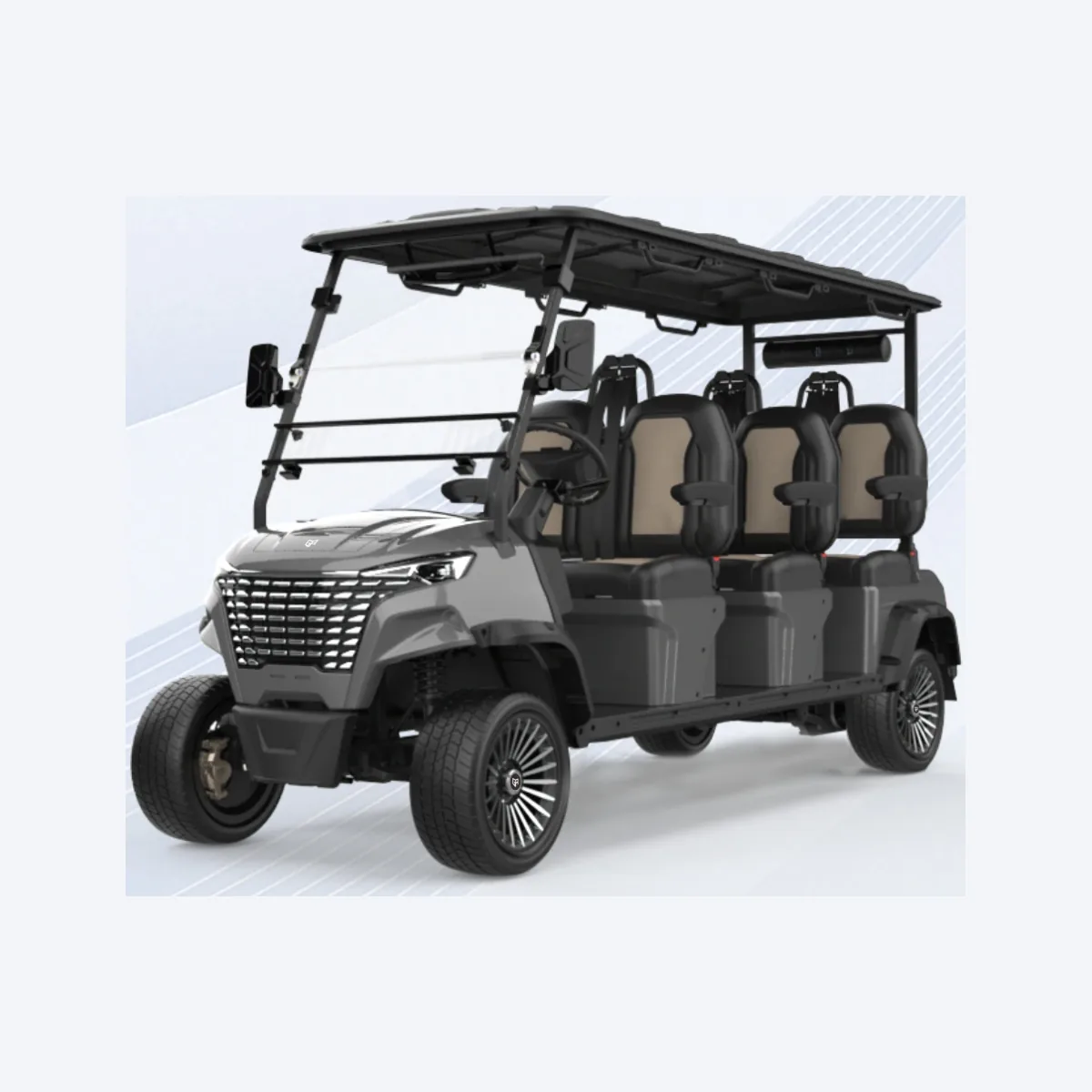
Golf Cart Seating: 2, 4, 6 and 8 Seats
What 2+2 and 4+2 mean, how seat count changes length and turning radius, and how to lay out a mixed fleet without oversizing it.
Quick answer
2 seats suits staff, 2+2 carries four and 4+2 carries six. A 3.67 m six-seater typically turns in 4.5 m, so measure paths and parking before choosing 6 or 8 seats.
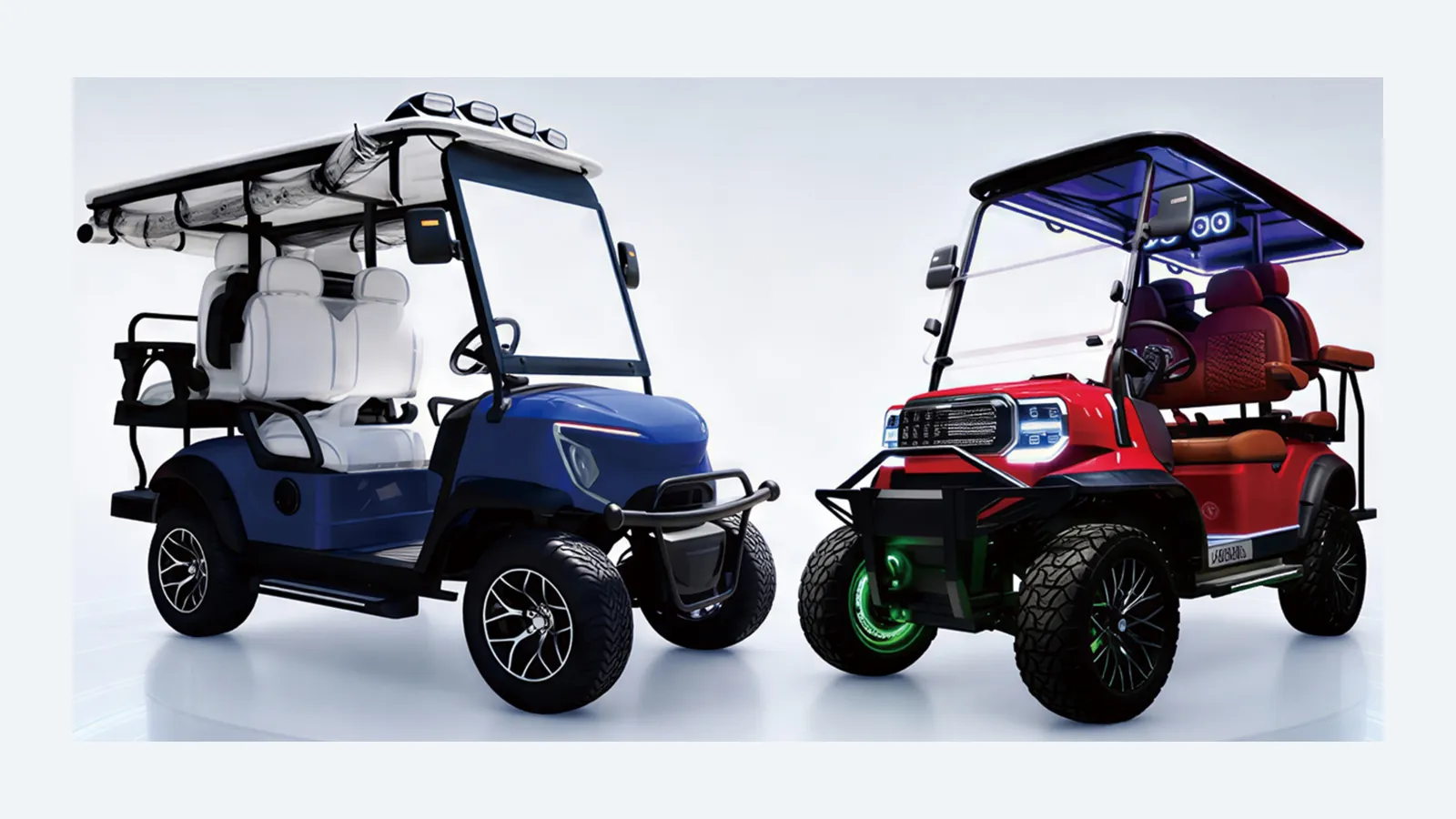
Seat count is the first thing buyers ask about and the last thing they should finalise. A cart that is too small creates a second trip; a cart that is too large turns every narrow path into a three-point manoeuvre and adds weight to every battery cycle. The useful question is not “how many seats can I get?” but “what is the largest group that must move in one trip, on the narrowest path the cart will use?”
This article explains the common layouts, the trade-offs behind them, and how to combine them into a fleet that stays manageable.
What do 2+2 and 4+2 actually mean?
The notation describes the seating layout, not the total seat count.
- 2 seats is a single forward bench. The space behind it is usually a bag well or a small cargo area.
- 2+2 means two forward-facing seats plus a rear-facing bench for two. Total: four passengers.
- 4+2 means four forward-facing seats (two rows) plus a rear-facing bench for two. Total: six passengers.
- 6+2 means six forward-facing seats plus two rear-facing. Total: eight passengers.
The rear-facing bench is popular in resorts and estates because passengers can step up from the rear and face each other during the trip. It also changes weight distribution and the rear overhang. On a golf course, the rear-facing bench is less common because bags and clubs need the rear space.
Some manufacturers describe the same layout differently, for example “4-seat 2+2” or “6-seat 4+2”. Always confirm the total passenger count and the direction of each bench, not just the label.
How many seats does a golf course need?
A golf course usually runs two kinds of cart: staff carts and guest carts.
Staff carts are two-seaters. Marshals, starters and maintenance staff travel alone or in pairs, often with tools or a radio. A 2.37–2.45 m body is easy to park, turns in about 4 m and puts less weight on turf.
Guest carts are usually four-seaters. Two players plus two bags fit on the benches and bag well. A 2+2 layout gives four seats but reduces the rear cargo space; a forward-facing four-seat layout gives more room for bags but a longer body.
If the course also runs tours or transfers, a six-seat cart can cover both guest groups and staff movements, but it will not fit every narrow path designed for two-seaters. Measure the narrowest bridge, gate and parking bay before choosing.
When should a resort choose six seats?
Six seats is the default for resort shuttles because it matches the common travel unit: a family, a small group or a couple with luggage. A 4+2 cart carries six adults, has a rear-facing bench for conversation, and remains short enough for most resort paths.
The trade-offs are real. A six-seat cart is roughly 3.67–3.72 m long, with a turning radius around 4.5–5 m. It weighs more, so acceleration and braking feel different from a two-seater. It also needs a larger parking bay and a charging position that does not block the path.
If the resort has multiple villa clusters, a mix of six-seat shuttles and two-seat utility carts is often more efficient than a fleet of six-seaters doing every job. The shuttles run the guest loop; the utility carts handle luggage, linen and maintenance.
What changes when you move to eight seats?
An eight-seat cart is closer to a small bus than to a golf cart. At around 4.25 m long, it needs wider paths, a larger turning area and a more careful loading plan. It is useful for staff and equipment movement on large campuses, and for attractions that need to move a group in one vehicle.
Before ordering, check:
- Path width and gate clearance on the route.
- Bridge and boardwalk load limits.
- Parking and charging bay dimensions.
- Whether the local vehicle category permits eight passengers.
- Whether a trailer or a second vehicle would be more practical.
For many sites, two six-seat carts are more flexible than one eight-seater, because they can operate independently at peak times and be parked separately.
How does seating affect payload and turning radius?
Every additional seat adds structure, weight and length. The table below shows the production models in this catalogue; the dimensions are body dimensions, and the turning radius is the published figure for each model.
| Model | Seats | Body length | Turning radius | Curb weight (excl. battery) |
|---|---|---|---|---|
| KR-G2 | 2 | 2.37 m | 4 m | ≤ 390 kg |
| KC-G2+2H | 4 | 2.43 m | 4 m | ≤ 485 kg |
| KR-G4+2 | 6 | 3.67 m | 4.5 m | ≤ 490 kg |
| KR-P6 | 6 | 3.72 m | 5 m | ≤ 530 kg |
| KC-P6H | 6 | 3.78 m | 4.5 m | ≤ 550 kg |
Payload is shared between passengers and cargo. A six-seat cart carrying six adults has little margin for luggage; a utility cart with a flatbed trades seats for load space. The order sheet should state the rated payload for the exact configuration, and the site should plan passenger and cargo weight together.
Can rear seats be removed for cargo?
Some rear benches are folding or removable, and some models can be specified with a flatbed instead of the rear bench. That flexibility is useful for sites that alternate between guest transport and light cargo.
It is not a substitute for a utility vehicle. Removing a bench does not change the chassis, axle rating or brake specification. If the cart will carry heavy or frequent cargo, choose a model designed with a bed, such as the KR-P6 or KC-P4, and confirm the load rating.
How do you lay out a mixed fleet?
A mixed fleet works when the roles are clearly separated and the platforms share service parts.
A practical layout for a resort might be:
- Three six-seat lithium shuttles for the guest loop.
- One six-seat utility cart for luggage and supplies.
- Two four-seat carts for housekeeping and maintenance.
- One two-seat cart for the duty manager.
A golf course might run:
- Four two-seat carts for marshals and starters.
- Twelve four-seat carts for guests.
- One utility cart for the range and supplies.
The exact numbers depend on peak demand, but the principle is the same: use the smallest vehicle that does the job, and keep the charging and service architecture consistent. A fleet of one platform is easier to train, stock and repair than a fleet of five unrelated models.
Before finalising, walk the route with a tape measure. The narrowest gate, the tightest turn and the loading bay will decide more than the brochure. If a six-seat cart does not fit, no amount of specification will fix it.
Models and next steps
Compare the full product range or open a model page for dimensions, battery, range and options:
- GC-A Classic 2-seat — 80–100 km, lead-acid or LiFePO4.
- GC-B Classic 4-seat — 60 km, 60 V lead-acid.
- KR-G2 Ridge 2-seat — 30–35 miles, 51.2 V LiFePO4.
- KR-G4+2 Ridge 6-seat — 30–35 miles, 4.5 m turning radius.
- KR-P6 Ridge utility 6-seat — flatbed and 2,860 mm wheelbase.
- KC-G2+2H Coast 4-seat — 2.43 m body, 190 mm clearance.
- KC-P4 Coast utility 4-seat — compact flatbed for campus work.
- KC-P6H Coast utility 6-seat — long flatbed and high clearance.
Related guides:
- How to choose the right golf cart
- Lithium vs lead-acid golf cart batteries
- Electric golf cart maintenance schedule
- Golf cart shipping and import checklist
- Sightseeing carts vs golf carts
Browse golf carts, utility vehicles and sightseeing carts. For a configuration-based quotation, send the seat count, route and destination or message the export desk on WhatsApp. You can also read about our export desk and see reference deployments.
The questions that decide the order.
What does 4+2 mean on a golf cart?
4+2 means four forward-facing seats plus a rear-facing bench for two more passengers, for a total of six. The rear bench can face backward so passengers step up from the rear.
Is a six-seat cart harder to drive?
It is longer and has a larger turning radius than a two-seater, but it remains a low-speed vehicle. The main adjustment is planning turns and parking; a 3.7 m six-seater typically has a 4.5 m turning radius.
Can I remove the rear seat for cargo?
Some rear benches are folding or removable, and some models can be specified with a flatbed instead. Load limits and mounting points must be confirmed at order; a purpose-built utility bed is better for heavy or frequent cargo.
How many seats does a resort shuttle need?
Six seats is the usual starting point for resort guest shuttles. It carries a family or a small group with luggage space, while remaining usable on older cart paths. Larger groups may need an eight-seat cart or a sightseeing shuttle.
Do more seats mean a larger battery?
Not necessarily a larger pack, but a heavier vehicle. The six-seat Ridge and Coast models in this catalogue use the same 51.2 V 105 Ah LiFePO4 pack as the two-seaters, with a similar 30–35 mile range; the extra weight affects acceleration, braking and range in real use.