Golf Cart Ground Clearance and Terrain Guide
What 140 mm and 190 mm ground clearance mean on a golf cart, which surfaces each suits, and the terrain questions to settle before ordering.
Ground clearance is the smallest gap between the vehicle and the ground, and it decides which surfaces a cart can cross without scraping. It is one of the few specifications a buyer can check with a tape measure after delivery, and one of the easiest to overlook when comparing models by seat count and battery.
The current range uses two figures: 140 mm on most models and 190 mm on the two high-clearance Coast models. The difference is 50 mm, about the height of a small step. That is enough to matter on gravel and unpaved paths, and not enough to turn a golf cart into an off-road vehicle.
What does minimum ground clearance actually measure?
Clearance is measured from the ground to the lowest point under the vehicle. That point is not always the axle or the differential; it can be a battery tray, a step, a suspension arm or a bumper. Ask which component sets the figure and whether it is measured at curb weight with the standard tyres.
Load changes the number. A cart with six passengers compresses its suspension more than an empty one, and a soft tyre lowers the body further. If the route includes a raised kerb or a drainage channel, ask for the loaded clearance rather than the empty figure.
Approach, departure and breakover angles are rarely published. If the route includes ramps or steep transitions, request them with the drawing. Clearance alone does not describe whether a cart will scrape its nose or its belly.
Which models use 140 mm and which use 190 mm?
| Clearance | Models | Body height | Typical setting |
|---|---|---|---|
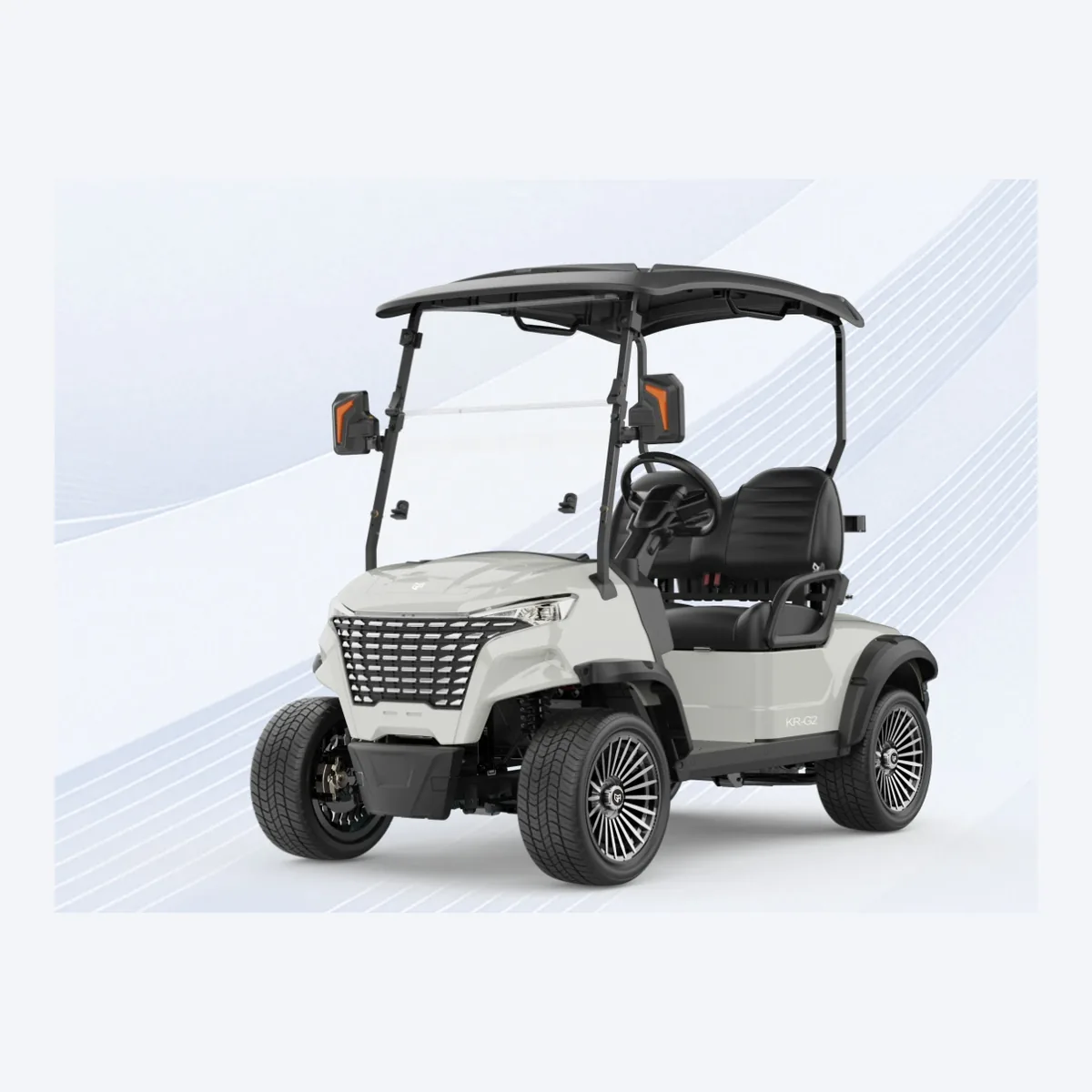
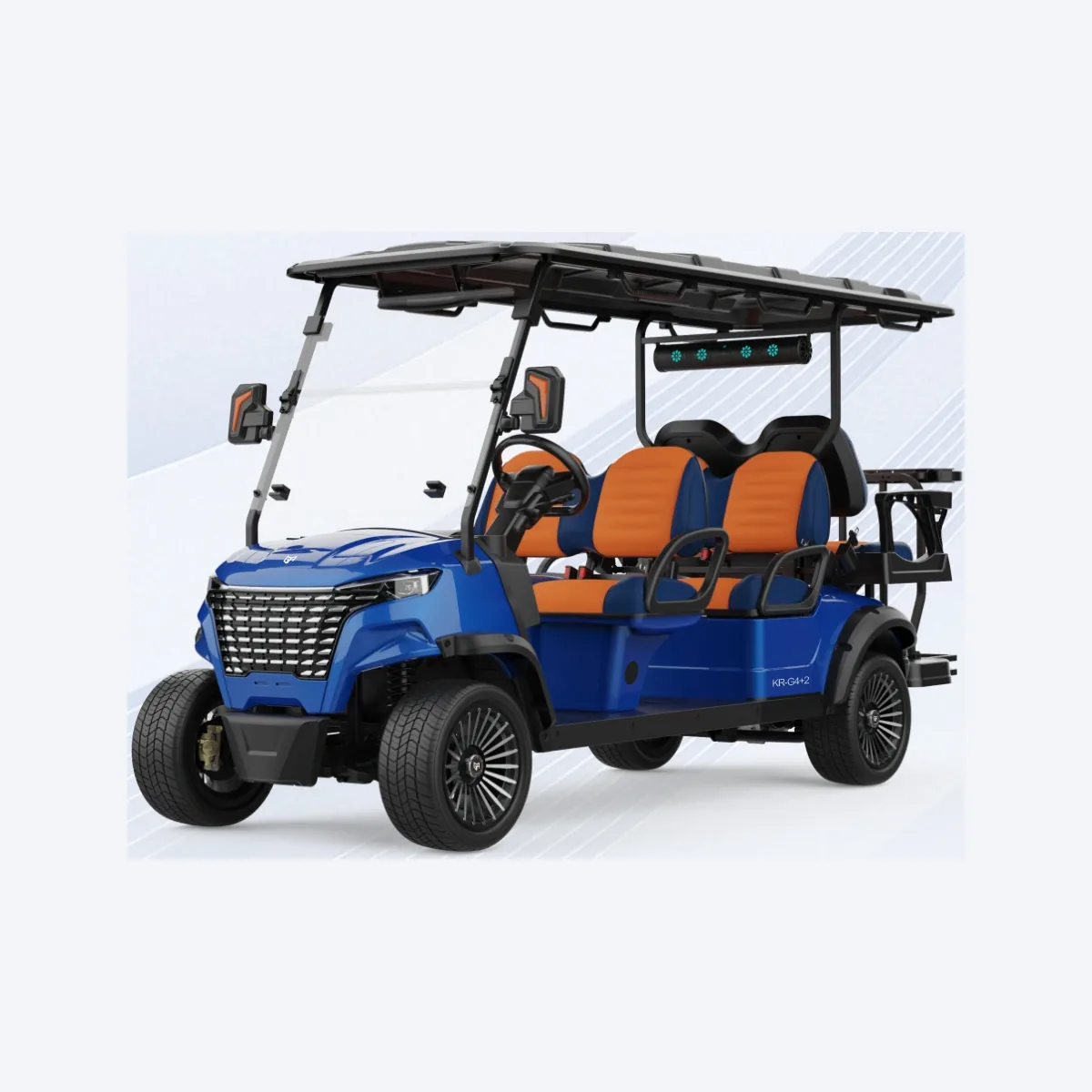
| 140 mm | KR-G2, KR-G4+2, KR-P6, KC-P4 | 2000 mm | Paved paths, turf, service yards |
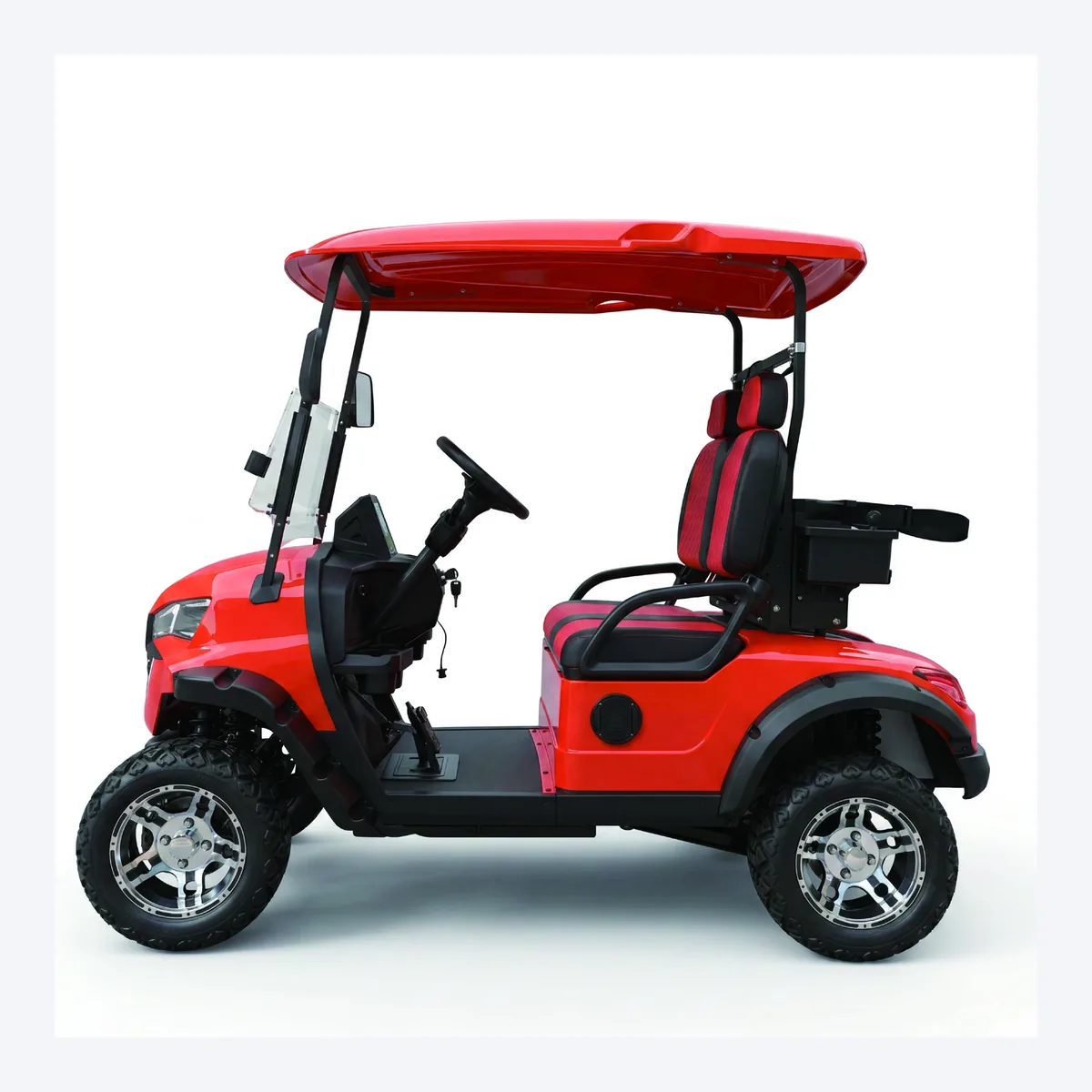
| 190 mm | KC-G2+2H, KC-P6H | 2040 mm / 2080 mm | Gravel, kerbs, unpaved paths |
The 140 mm models cover the passenger and utility range. The 190 mm models are the KC-G2+2H and the KC-P6H. Their body heights are 2040 mm and 2080 mm, against 2000 mm for the 140 mm models, so the extra clearance comes with a taller body as well as a higher step.
The GC-A and GC-B summaries do not publish a clearance figure. Their body dimensions and track are listed, but the clearance has to come from the dimensioned drawing for the exact configuration.
Is 140 mm enough for a golf course?
For a golf course, 140 mm is usually adequate. Cart paths are paved or rolled, turf is mown and kerbs are low or ramped. The problems appear at the edges: a path that ends in gravel, a washed-out drain, a root that lifts the surface, a kerb without a ramp, or a temporary track across a field.
Clearance does not solve traction. Wet turf, loose gravel and mud reduce grip regardless of height, and a higher cart can still slide. If the route leaves the path, the surface and the tyres matter as much as the number.
A course that keeps its fleet on paths and turf has little reason to pay for extra clearance. A course with a gravel service loop, a farm track or a seasonally unpaved section is a different case.
When does 190 mm make a real difference?
Gravel drives, kerbs and unpaved resort paths are the cases named for the high-clearance models. The extra 50 mm keeps the underside clear of loose stones and raised edges that would touch a 140 mm cart, and it gives more margin when the cart is loaded.
The KC-G2+2H is the compact option: four seats in 2430 mm, a 4 m turning radius and 190 mm of clearance, with a 2040 mm body height. The KC-P6H is the long utility option: six seats, a flatbed, 3780 mm long, a 4.5 m turning radius and 190 mm of clearance.
The trade-off is boarding height. A 190 mm clearance raises the floor slightly; most passengers step in without difficulty, but a fleet that serves elderly guests may prefer a step or a lower-clearance passenger model for that duty.
How do tyres, load and suspension affect real clearance?
Tyres set the first part of the number. The GC-A uses 20 × 10-12 tyres on aluminium alloy rims and the GC-B uses the same size on steel rims. Tyre size is not published for every lithium model, so confirm it with the drawing if the route depends on clearance.
Tyre pressure and sidewall height change the gap by a few millimetres, and a loaded cart sits lower than an empty one. Suspension design matters on rough ground: the GC-B uses a MacPherson independent front suspension and an integrated rear axle, while the GC-A uses an independent front and a torsion beam rear. The lithium platform lists a MacPherson front and an integral rear axle. None of these makes the cart immune to a hard edge; they only decide how the body moves over it.
Which terrain questions belong in the route survey?
| Surface | What to check | Clearance to plan for |
|---|---|---|
| Paved cart path | kerb height, drains, speed humps | 140 mm |
| Managed turf | wet patches, aeration holes, root heave | 140 mm |
| Compacted gravel | loose stone, washouts, camber | 190 mm |
| Unpaved service road | ruts, potholes, grass strip | 190 mm |
| Kerbs and ramps | lip height, ramp angle, breakover | 190 mm |
| Boardwalk or bridge | width, load limit, deck joints | Check weight limit |
| Indoor storage | door sill, threshold height | Check height and sill |
These are planning guides, not guarantees. A 140 mm cart can cross a gravel drive slowly, and a 190 mm cart can still ground on a rock or in a deep rut. The route survey and a loaded test decide.
What are the trade-offs of a higher-clearance cart?
Higher clearance raises the floor and the centre of gravity. The first affects boarding, the second affects stability at speed and on side slopes. The 190 mm models are also taller: 2040 mm for the KC-G2+2H and 2080 mm for the KC-P6H, against 2000 mm for most 140 mm models. Check doorways, canopies and transport clearances.
For passenger duty on paved paths, 140 mm is usually the better compromise: a lower step, a lower roof and a lower centre of gravity. For grounds, gardens and unpaved service roads, 190 mm earns its place.
How should clearance be specified in the order?
State the surface and the worst obstacle on the route, not just the clearance figure. Ask for the loaded clearance, the tyre size, the lowest component, and the approach and departure angles. If the answer is a range rather than a single number, ask what condition it describes.
Clearance is also a maintenance item. Tyre pressure, damaged suspension and bent underbody guards all change it, so add a visual check to the daily or weekly routine.
The questions that decide the order.
Is 190 mm enough for gravel?
The high-clearance models are specified for gravel, kerbs and unpaved resort paths. Whether 190 mm is enough depends on stone size, rut depth, load and approach angle. Send photographs and the worst section of the route with the enquiry, and confirm the loaded clearance rather than the empty figure.
Does ground clearance change with load?
Yes. Suspension compresses under passengers and cargo, and tyre pressure changes the gap as well. Ask for the loaded clearance for the configuration you are buying, especially if the route includes kerbs, ramps or drainage channels.
Can clearance be increased after delivery?
Changing tyres or suspension changes the steering geometry, the centre of gravity and the braking behaviour. It should be specified at order rather than added later. If the route needs more clearance, choose a high-clearance model instead of modifying a standard one.
Which models have 190 mm of clearance?
The KC-G2+2H and KC-P6H are published at 190 mm. The KR-G2, KR-G4+2, KR-P6 and KC-P4 are published at 140 mm. The GC-A and GC-B summaries do not state a clearance figure, so request the dimensioned drawing for those models.