Resort Shuttle Fleet Sizing
How to size a resort shuttle fleet from arrival waves: passenger trips, round-trip time, seats per cart, spare ratio and route structure.
Quick answer
For a 120-key resort, plan around 3 six-seat shuttles, 1 luggage cart and 2 housekeeping carts. Size from the 30-minute arrival wave and a 5-hour overnight charge.
Resort shuttle demand arrives in waves. A flight bank lands, a conference breaks, or dinner service ends, and for twenty minutes the lobby needs more seats than an average day suggests. The fleet question is how many vehicles keep the wait acceptable during that wave without buying vehicles that sit idle the rest of the week.
This guide follows the same method as our fleet calculator: passenger trips become vehicle trips, vehicle trips are divided by the trips one cart can complete in an hour, and a spare ratio is added before rounding up. Every example is a planning assumption, not a measured result from a specific property.
Why is an arrival wave harder to plan than average occupancy?
Average occupancy hides the shape of the day. A 120-key resort might report 70% occupancy for the month, then check in 80 guests between 14:00 and 16:00 on a Saturday. That is roughly 40 passenger trips per hour, not a smooth trickle spread across the day.
Flight banks, conference programmes and dinner seatings create the same pattern. Departures overlap with arrivals, so a cart may be carrying luggage out while another group waits to be taken to a villa. Count the guests who need a ride in the busiest hour, and count them as individuals rather than rooms: a couple is two trips, a family of four is four.
How long is a resort shuttle round trip?
Round-trip time is the full cycle, not the one-way drive. Start at the lobby or arrival court, load passengers and luggage, drive to the furthest stop on the route, unload, and return to the start. Add a realistic dwell at each stop, because a shuttle that waits for a family to find its key card loses more time than the map suggests.
Drive the route at the speed the cart will actually use. A 32 km/h vehicle on a service road with speed humps, gate barriers and pedestrian crossings is not travelling at its top speed. If the loop serves several villas, time each stop separately. A conservative estimate protects the guest experience; an optimistic one produces a fleet that is short every afternoon.
How do you size a shuttle fleet from passenger flow?
The calculation has four steps:
- Vehicle trips = passenger trips ÷ seats per cart.
- Trips per cart per hour = 60 ÷ round-trip minutes.
- Base carts = vehicle trips ÷ trips per cart per hour, rounded up.
- Add the spare ratio and round up again.
Worked example, with assumptions stated: a 120-key resort expects 40 guest trips in the peak arrival hour, the lobby-to-villa loop takes 15 minutes, shuttles seat six and the property plans a 15% spare.
- Trips per cart per hour: 60 ÷ 15 = 4.
- Vehicle trips: 40 ÷ 6 = 6.7.
- Base carts: 6.7 ÷ 4 = 1.7, rounded up to 2.
- With spare: 2 × 1.15 = 2.3, rounded up to 3 shuttles.
The same method at three resort scales:
| Design case | Peak guest trips/hour | Round trip (min) | Seats | Spare | Carts |
|---|---|---|---|---|---|
| Boutique, 60 keys | 16 | 12 | 6 | 15% | 2 |
| 120 keys, one loop | 40 | 15 | 6 | 15% | 3 |
| Large property, two loops | 72 | 18 | 6 | 20% | 5 |
The result is a planning estimate. It does not include driver breaks, dispatch delays or the time a cart spends waiting at a stop. Allow for them with a conservative round-trip time and a higher spare ratio, or treat the output as a floor rather than a final number.
How many seats should each shuttle have?
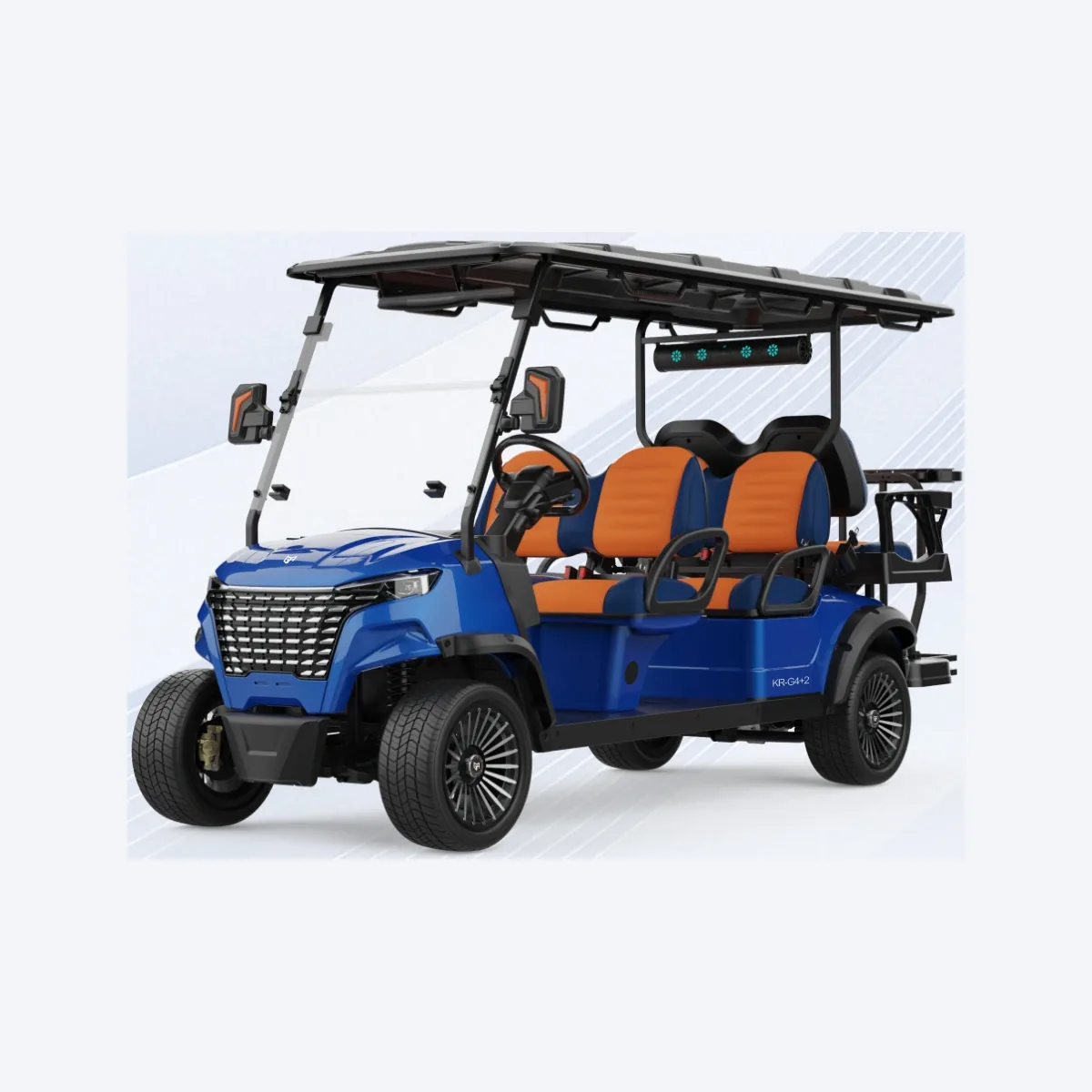
A six-seat layout matches the common travel unit: a couple with luggage, a family, or a small group going to the beach club. A six-seat cart such as the KR-G4+2 is 3.67 m long with a 4.5 m turning radius and 30–35 miles of rated range, which covers repeated resort loops with a midday opportunity charge.
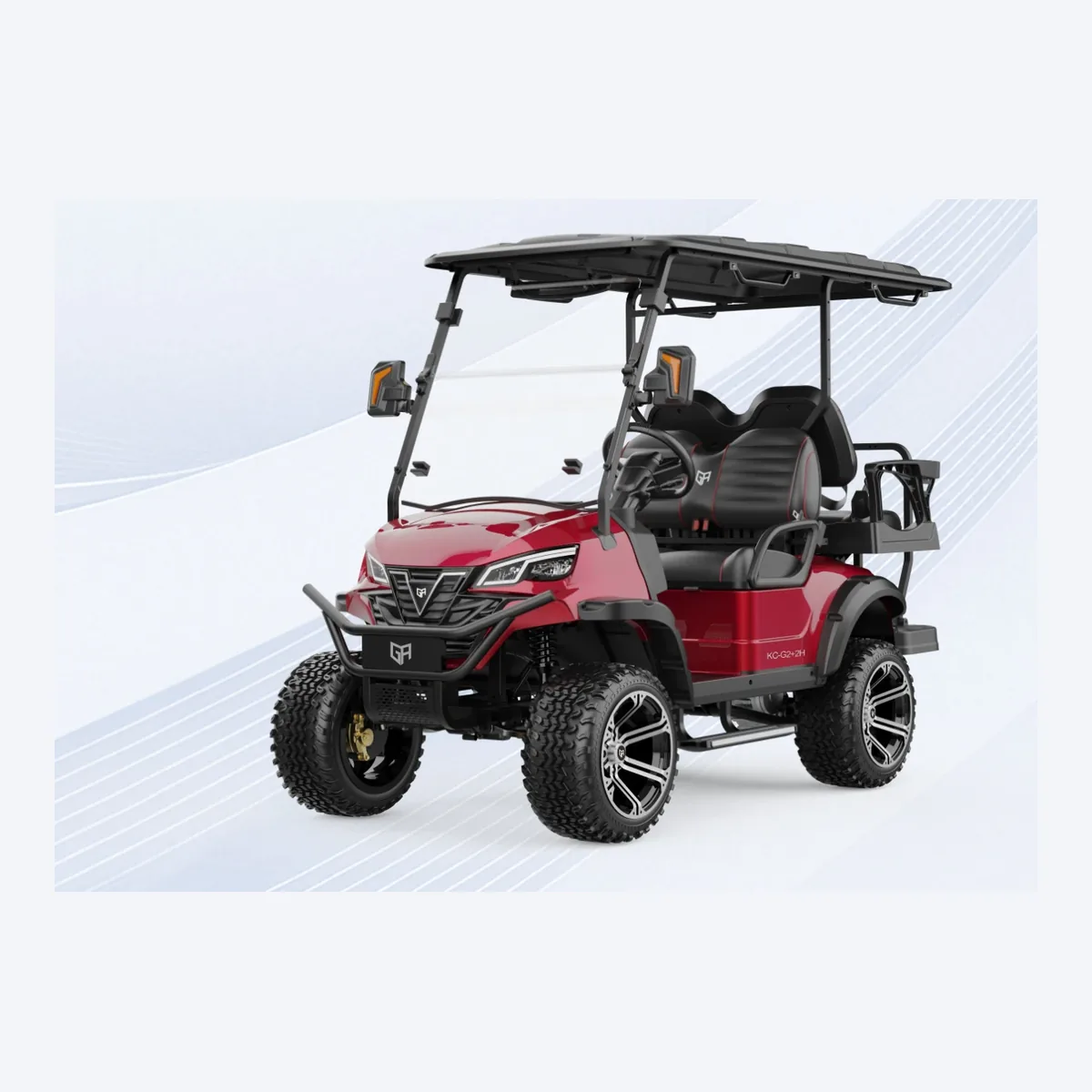
A compact four-seater has a different job. The KC-G2+2H is 2.43 m long with a 4 m turning radius and 190 mm of clearance, so it fits tight forecourts, gravel drives and service corridors. It suits VIP transfers, luggage runs and housekeeping, while the six-seater handles group arrivals.
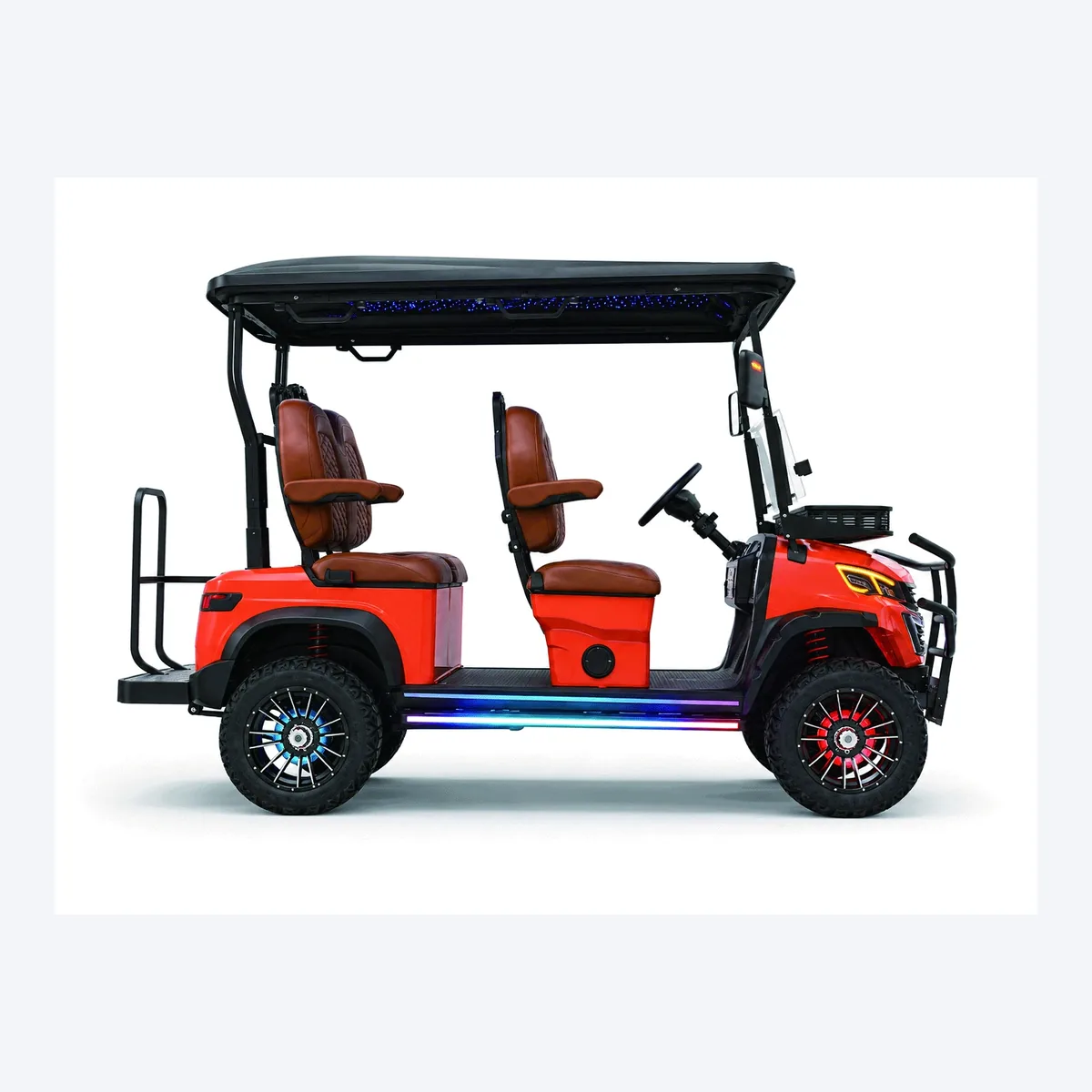
Mixing seat counts works best when the vehicles share a drivetrain. The Coast and Ridge models both use a 48 V 5 kW IP67 motor and a 51.2 V 105 Ah LiFePO4 pack, so one charger specification and one set of service procedures cover the mixed fleet.
What spare ratio does a resort need?
A spare ratio of 15–20% is a common planning range. Resort routes are often longer than golf course loops, service continues into the evening, and coastal humidity or dust increases maintenance. A property with one charging window or no on-site technician should plan at the upper end.
A spare vehicle is only useful if a driver is available. If the shuttle team has no relief driver, a spare cart sits in the yard while the service fails. Plan driver cover and vehicle cover together, and keep the spare charged and road-ready rather than using it as a storage shelf.
How do multiple routes and shifts change the answer?
If the property runs separate loops that do not overlap, size each loop and add the results. A lobby-to-villa loop needing three shuttles and a lobby-to-beach loop needing two require five vehicles unless a cart can complete one loop and transfer to the other within the same hour. Transfer time, dispatch control and guest waiting tolerance decide whether a shared pool is realistic.
Shift changes create a second demand stream. Staff arriving at 06:00 and leaving at 22:00 may need transport that does not appear in the guest arrival count. Size that flow separately, then check the charging window: a lithium fleet that recharges in five hours or less can work a split shift more easily than a lead-acid fleet that needs a full overnight charge.
Send the route map, the peak arrival profile, the furthest stop and the charging window with the enquiry. We will test the estimate against the paths and the model mix before proposing a shuttle configuration.
The questions that decide the order.
How do I estimate resort passenger trips per hour?
Count guests, not rooms, during the busiest arrival or departure wave. A couple is two passenger trips and a family of four is four. Use the hour with the highest overlap of check-ins, check-outs and internal transfers, not average occupancy.
What round-trip time should I enter?
The full cycle from the lobby to the furthest stop and back, including loading, luggage, dwell and the return leg. Drive the route at the speed the cart will actually use, then add time for each stop.
Is a six-seat cart always the right resort shuttle?
Six seats suits families and small groups and is the usual default. A compact four-seater is better for VIP transfers, luggage and narrow forecourts. Many resorts run both, keeping one drivetrain family to simplify charging and parts.
Why does the calculator add spare carts after rounding?
The method first rounds the base fleet up to whole vehicles, then applies the spare ratio and rounds up again. That keeps the spare attached to a complete vehicle rather than to a fraction of one, and avoids understating the fleet at peak.