2, 4 and 6 Seater Golf Cart Price Factors
How seat count changes a golf cart quotation: structure, length, weight, battery load and cost per passenger across two-, four- and six-seat layouts.
Quick answer
Seat count drives length, weight and battery load: a 2-seat cart runs about 2.4 m, a 4-seat about 2.9 m and a 6-seat about 3.7 m. Compare the 51.2 V 105 Ah pack and 5-hour charge across quotations.
Seat count is the first question most buyers ask and the easiest one to price badly. The step from two to four seats and from four to six is not a linear multiple of the two-seat price. Each layout adds structure, length and weight in different proportions, and each changes what the vehicle can do on a site. Understanding those steps makes a quotation easier to read and easier to challenge.
This guide explains what each additional seat puts into the bill of materials, why six-seat carts cost more to run as well as to buy, and how to compare the three layouts on a per-passenger basis.
Why does seat count change the price at all?
Every seat is a place on a bench, but the bench needs a floor, a frame, a mounting point, a cushion and a belt. Adding a row lengthens the chassis and the body, which changes the tooling, the paint area and the packing dimensions. Adding a rear-facing bench adds a step, a handrail and a structural extension behind the rear axle.
The drivetrain is not multiplied with the seats. Motors, controllers, chargers and lighting are shared across a family, so the platform cost is carried once. Tooling is amortised across that family too, which is why a layout that shares panels and frames with an existing model is cheaper to quote than one that needs new moulds. That is why a six-seat cart is more expensive than a two-seater but not three times the price, and why the middle layout often looks like the best value on paper.
What does each extra seat add to the vehicle?
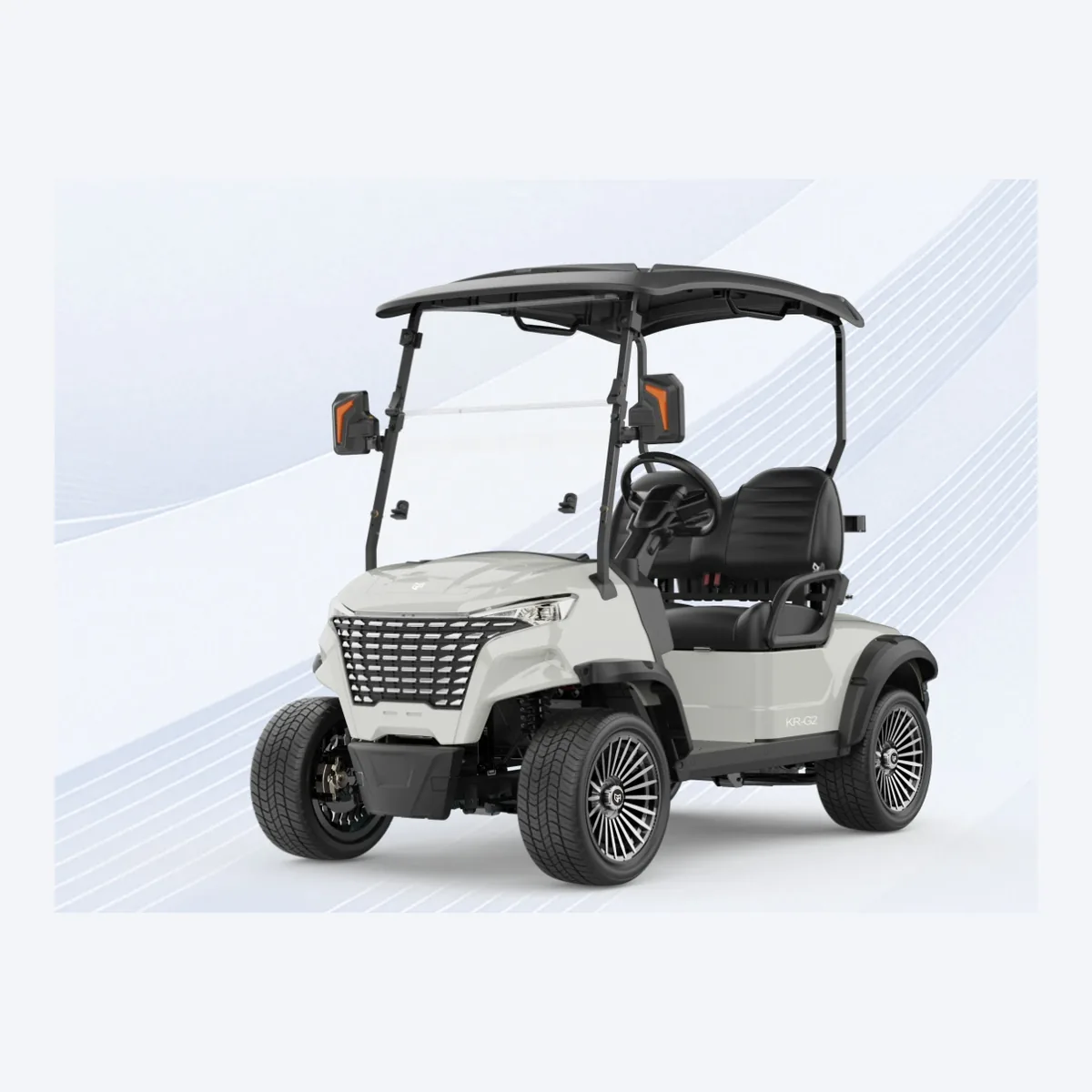
A two-seat cart such as the KR-G2 is 2370 mm long with a 1675 mm wheelbase and a 4 m turning radius. It is a staff vehicle: marshal, starter, maintenance, security. The body is short, the weight is low and the parking demand is minimal.
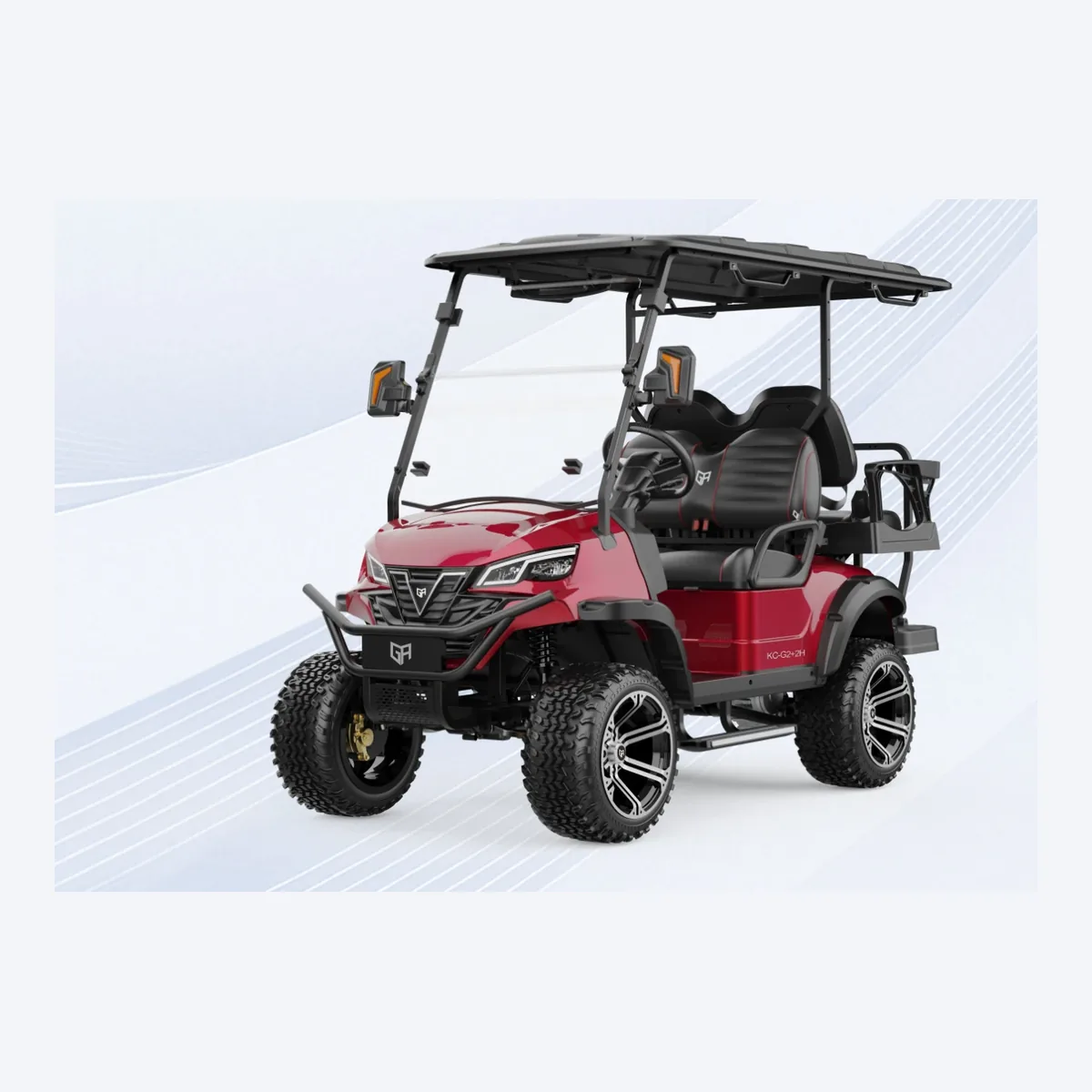
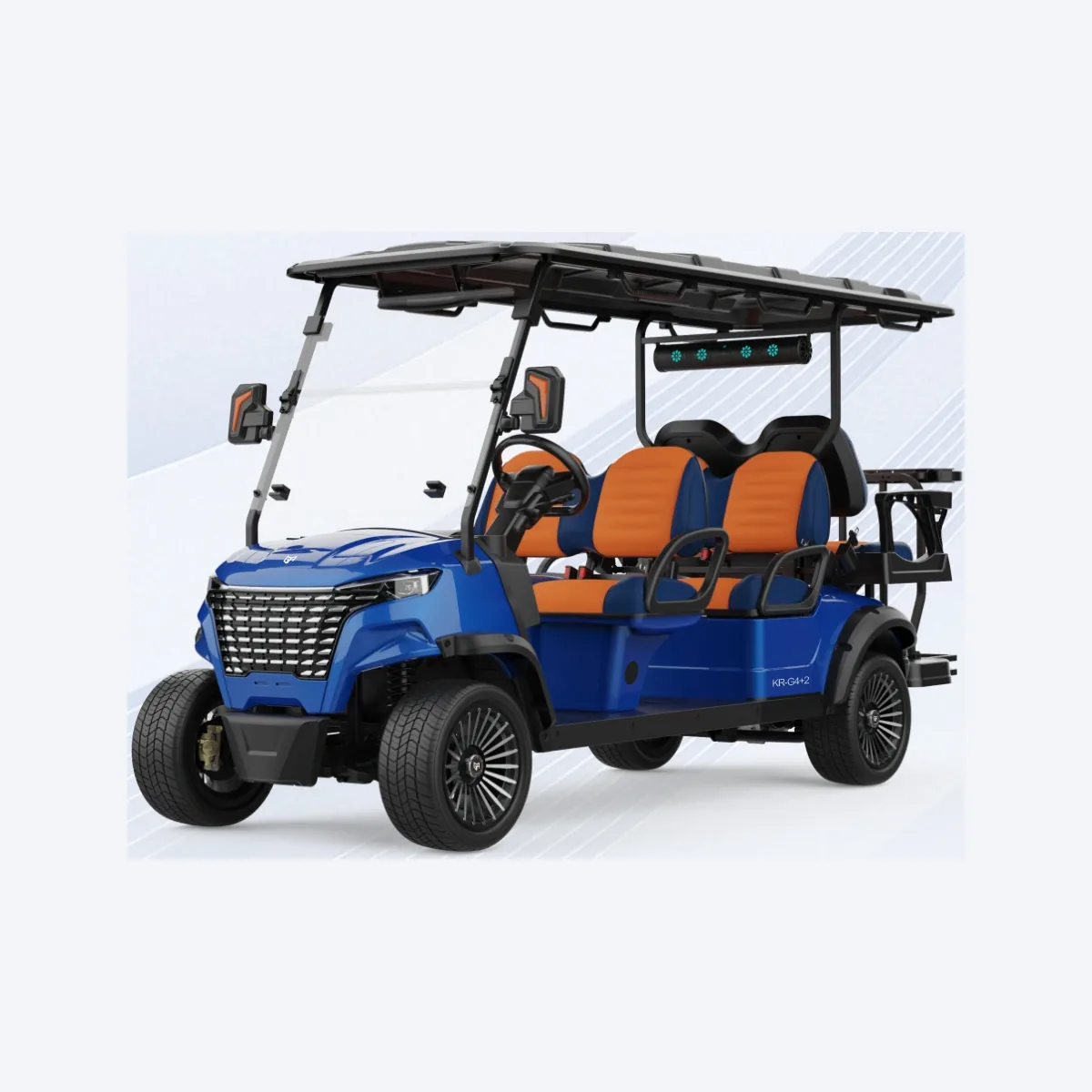
A four-seat cart comes in two shapes. The GC-B is a 2950 mm two-bench vehicle; the KC-G2+2H packs four seats into 2430 mm with a 190 mm clearance. The compact layout costs less in body length but puts the rear passengers close to the axle. A six-seat cart such as the KR-G4+2 is 3670 mm long with a 4.5 m turning radius, and a utility six-seater such as the KC-P6H reaches 3780 mm. Packing follows length: fewer long vehicles fit in a container than short ones, and that difference is quoted as freight rather than as vehicle price.
| Seats | Example models | Body length | What changes in the cost structure |
|---|---|---|---|
| 2 | KR-G2, GC-A | 2370–2450 mm | Shortest body, smallest packing volume, lowest weight |
| 4 | KC-G2+2H, GC-B | 2430–2950 mm | Extra bench, longer body or higher clearance, more trim |
| 6 | KR-G4+2, KC-P6H | 3670–3780 mm | Long chassis, rear bench structure, larger packing |
| 6 utility | KR-P6 | 3720 mm | Flatbed replaces rear seats; payload and bed hardware |
Do six-seat carts cost more to run?
Yes, in most fleets. A longer, heavier vehicle uses more energy per trip and wears tyres and brakes faster. It also needs a longer parking bay and a charging position that does not block a path. The difference is modest per vehicle but visible across a fleet that covers many trips a day.
The operational cost that buyers miss is the empty-seat cost. A six-seater dispatched for two passengers burns the same energy as one carrying six. If the site’s demand is mostly pairs, a four-seat fleet does the same work with less vehicle. If demand is families and groups, the six-seater removes second trips, and the saving shows up in labour rather than in energy.
How do 2+2 and 4+2 layouts change the quotation?
A 2+2 layout carries four passengers in a shorter body: two forward-facing seats and a rear-facing bench. It is cheaper to buy than a full four-seat bench layout and easier to park, but rear passengers face backwards and luggage space shrinks. A 4+2 layout carries six in two forward rows plus a rear-facing bench, which is the usual resort shuttle configuration.
The quotation should state the layout, not just the seat count. Two vehicles with four seats can differ in body length, bench type, step, handrail and bag space. Those differences are visible on the order sheet and invisible in a headline seat count.
Which seat count gives the best cost per passenger?
The answer depends on the load the site actually carries. Divide the quoted unit price by the average number of passengers per trip, not by the number of seats. A six-seater at full load usually wins; a six-seater at quarter load rarely does.
Run the same calculation for the fleet, not the vehicle. If peak demand needs three six-seaters but off-peak needs two two-seaters, a mixed fleet can cover both without running large vehicles empty. The comparison should include charging positions, parking bays and spare parts, because those costs follow the fleet size, not the seat count.
The arithmetic also changes with the spare ratio. A large vehicle bought to cover peak demand may sit idle off-peak, while two smaller vehicles can be rotated and kept productive. Price per seat hides that utilisation difference; price per passenger-trip exposes it.
When does a mixed fleet cost less overall?
A mixed fleet costs less when duties are clearly separated. Staff and maintenance run short loops alone; guest shuttles carry groups; housekeeping moves linen and two cleaners. Matching each duty to the smallest vehicle that does the job reduces energy, tyre wear and parking demand.
The savings depend on standardising across a platform. On the Ridge and Coast families, the 48 V 5 kW IP67 drivetrain and the 51.2 V 105 Ah LiFePO4 pack are shared, so chargers, controllers and service procedures stay common even when seat counts differ. Ask for the quotation to show the shared platform explicitly; that is where the fleet-level saving is easiest to verify.
The questions that decide the order.
Does a six-seat cart cost twice as much as a two-seater?
No. Seat count adds structure, body length and weight, but the drivetrain, charger, lighting and instrumentation are shared across a platform. The price step from two to four seats is usually smaller than the step from four to six because the rear bench and longer chassis change the body and the packing.
Which seat count has the lowest price per passenger?
Per passenger, the six-seat layout spreads the platform cost across the most seats, but only if the seats are used. A six-seater running with two passengers costs more per trip than a two-seater. The useful measure is cost per passenger-trip at the site's typical load, not cost per seat.
Is a four-seat cart cheaper to run than a six-seater?
Usually yes, because it is lighter and shorter. Weight affects acceleration, braking and energy use, and length affects parking and charging space. On the same lithium platform, the four-seat KC-G2+2H and the six-seat KR-G4+2 share a pack, but the six-seater carries more mass per charge.
Can a mixed fleet reduce the total price?
It can reduce the cost of covering the same duties. Two-seaters for staff and six-seaters for guest loops avoid moving empty seats all day. Standardising the mixed fleet on one platform keeps chargers, controllers and spare parts common, which is where the savings usually sit.